Cloudflare expands its nonprofit startup program, backing more civil-society automation projects with credits, while detailing several deployments that illustrate how AI and a secure cloud can support advocacy, crisis response, and online free expression.
GitHub has deprecated selected Copilot models across all experiences, guiding administrators to enable alternative models and verify policy settings. The change affects Copilot Chat, inline edits, agent modes, and code completions, with steps for admins to update workflows and access.
GitHub has completed the staged rollout of stateless GitHub App installation tokens. Newly minted tokens default to a stateless JWT format, with longer token strings and unchanged permissions and endpoints, alongside a deprecation timeline for a validation header.
Cloudflare announces a closed beta for its OHTTP Gateway, expanding access to its privacy-preserving infrastructure with two deployment options and a pay-on-add-on model.
Amazon announces it will halt NDAs in data-center dealings with government agencies and pledges a $1 billion, five-year investment in host communities, as scrutiny of data-center project secrecy grows.
Cloudflare announces eight major updates to its Observability platform, unifying logs, traces, analytics, alerts, dashboards, and exporting, along with new pricing and longer data retention.
Cloudflare introduces Streamline, a developer playground that enables custom video pipelines on Cloudflare Stream and Workers, featuring a long-running media engine in containers, orchestration with Durable Objects, and real-time previews via WebSocket.
Cloudflare introduces Protected Quick Tunnels, enabling email-authenticated access to local services without requiring a Cloudflare account, backed by a new flag and a stateless broker.
Cloudflare Traces in open beta extends automatic tracing beyond Workers to the full request path, providing end-to-end visibility and interoperability with OpenTelemetry.
GitHub expands Copilot code review with API-based access and a new default effort level, enabling teams to integrate AI-assisted reviews into their own tools while standardizing the review effort.
A GitHub Blog post discusses how AI-powered workflows are changing developer work and signals that developers should focus on three key skills, as outlined by Gwen Davis, a GitHub content strategist.
Cloudflare says it is closing the gap between Enterprise features and consumer plans, expanding data-delivery, governance, and developer tools to all customers while rolling out new account management and organizational controls.
Cloudflare announces a new Web Search API integrated into AI Gateway, enabling live web browsing to ground AI-model responses, with partnerships, BYOK options, and transparent crawler rules.
AWS announces the public preview of an AI-powered service that analyzes your AWS environment to deliver contextual recommendations for improving cost, security, performance, and resilience, with implementation guidance and IaC changes.
Cloudflare announces a significant update to its network performance measurements during Birthday Week 2026, highlighting a rise to fastest status in 74% of the world's 1,000 largest networks and detailing a new measurement methodology using Cloudflare Challenge Pages.
Cloudflare introduces a new dashboard that helps fraud analysts investigate account abuse by linking login and signup activity to privacy-preserving Hashed User IDs, supported by a stateful trust model and role-based access control. Early Access is limited to specified customers.
GitHub adds REST API endpoints to manage comments on repository security advisories, expanding beyond the web UI to support programmatic triage, audits, and workflows.
GitHub announces enhancements to the SecurityAdvisory GraphQL API, introducing new fields and filters to improve access to the GitHub Advisory Database from GraphQL.
GitLab Threat Research Group discloses a critical command execution vulnerability in DeepSeek-Reasonix Studio that can execute attacker-controlled code when a developer views a file diff. The flaw, known as ConfigPoisoning, is being addressed with specific updates and broad mitigation guidance.
The Python documentation has been published in German, extending access for German-speaking developers and learners. The initiative was driven by community contributors, and Python notes that translations rely on ongoing participation to stay accurate and up to date, with guidance available via the Translation dashboard and Python Developer’s Guide.
Turnstile Spin is an agent-mediated end-to-end implementation of Cloudflare Turnstile, designed to simplify embedding and backend verification through AI-enabled workflows.
GitHub has introduced an in-product validator for enterprise managed settings in Copilot, designed to detect misconfigurations and other errors that could block enterprise deployments.
GitHub has updated how query results are counted for workflow runs in both the Actions API and the UI. The change results in counts that are less precise but more accurate when filtering by workflow, event, status, branch, and related fields.
GitHub’s changelog confirms that Agentic autofix now uses Copilot Memory for customers who’ve enabled it, with the feature reviewing existing memories to aid in resolving security alerts.
OpenAI reveals a six-pillar blueprint designed to safeguard and empower young people in AI experiences, outlining a roadmap for safer youth interactions with AI.
JetBrains’ Junie /demo adds an automated demo mode to Junie CLI, enabling developers to describe a check, let Junie build and launch the app, interact with the UI, and produce shareable evidence (HTML reports, screenshots, and videos). The integration with CI and GitHub Actions supports broader demo workflows, while the feature emphasizes offloading repetitive GUI checks and keeping results inspectable.
GitHub's Copilot code review has been updated to offer a clearer timeline of changes, improved auto-resolution of suggestions, and automatic commit message generation when you accept suggestions.
GitHub has announced that selected Copilot models will be deprecated across all Copilot experiences on October 19, 2026, spanning Copilot Chat, inline edits, ask and agent modes, and code completions.
Apple’s latest hardware lineup—iPhone 18 Pro, Apple Watch Series 12, Apple Watch Ultra 4, and AirPods 5—starts arriving in stores worldwide, signaling the global retail rollout of the new generation.
Cloudflare reports that small, math-backed optimizations to a Pingora-based service reduced its memory footprint by about 25%, enabling the reclaiming of more than 100TB of RAM globally, in addition to 100TB shed by the DNS team last month.
A summary of Google's Ads Decoded episode focusing on data strength in lead-gen campaigns, the expansion of Data Manager, and pilots for lead intent scoring and journey-aware bidding.
JetBrains’ Junie Local update merges two Qiwen-style models into a single 27B on-device model, improving speed and token efficiency for coding tasks while maintaining competitive task completion.
Ktor 3.6.0 is now available, bringing typed authentication, an OpenID Connect plugin, and experimental HTTP/3 support for the Netty engine, along with several routing, client, and caching enhancements.
JetBrains outlines the AIDEs Framework, a structured theory aiming to explain how artificial intelligence is shaping software creation. The framework defines key concepts, foundational assumptions, and three dimensions of development work, with implications for how teams adopt AI tools today and plan for the future.
OpenAI News reports on a developing call for stronger AI safeguards as the policy window remains open, with Chris Lehane urging three core actions to guide future AI development.
Apple unveils the Apple Watch Ultra 4 and Series 12, emphasizing a software-forward upgrade with Audio Intelligence features designed to help users stay present and manage daily conversations, along with health-sensing improvements and new readiness insights.
Kubernetes 1.37 adds five Node lifecycle conditions to describe draining, maintenance, and Graceful Node Shutdown, providing a common signal for operators and automation.
TechStaged reports on CodeQL 2.27.0, including Linux ARM64 support, a new Rust security query, and expanded language coverage with improved analysis accuracy.
OpenAI Foundation announces the appointment of Paul Christiano to its Board and to the Safety and Security Committee, highlighting his background in AI alignment and safety.
GitHub has expanded access to its self-serve GitHub Advanced Security trial, allowing more Enterprise Cloud customers to evaluate Code Security and Secret Protection.
Google Accelerators mark ten years of supporting high-potential startups with equity-free access to Google technology, mentorship, and a four-program framework that spans early-stage startups, social impact, AI labs, and app developers.
A documentary short demonstrates how AI can help recreate moments from a long life when memory is fading, by rebuilding an unrecorded past frame by frame with input from the couple and a human-guided AI workflow.
Atlassian is discontinuing sales and support for Data Center products, prompting a guided migration path to YouTrack through live webinars. The events include a demo, customer stories, and practical steps for migrating from Jira, Confluence, and Jira Service Management to YouTrack, with English, Japanese, and Russian sessions.
JetBrains has consolidated WSL support across IntelliJ IDEA, WebStorm, and PhpStorm into a single recommended approach: Native mode. This mode runs the IDE as a Windows application while a lightweight agent inside WSL handles files and processes on its behalf. The move follows years of experimentation with multiple architectures.
Cloudflare updates its Workers runtime by reworking the core module registry to better align with Node.js, enabling default API compatibility, revamped module resolution, and updated bundling behavior.
JetBrains documents how Rig standardizes interaction with LLM providers in Rust, enabling agents, tools, RAG, streaming, and local inference, with a live-stream series illustrating practical usage.
TechStaged reports on Google's announced blueprint for responsible energy growth in Finland, detailing a nuclear life-extension agreement, expansions in wind and energy storage, smart siting, and programs for community resilience.
Google unveils a €13 billion investment in Finland aimed at expanding AI infrastructure, digital networks, and clean energy, while strengthening local partnerships and community programs.
GitHub announces an update to Copilot for JetBrains introducing enterprise-managed sandbox policies, cross-file cursor jumps for next edit suggestions, global project context in chat, enterprise policy diagnostics, and a terminal Copilot connection.
GitHub Enterprise Server 3.22 is now generally available, introducing new platform capabilities. A release note highlights that administrators can configure Copilot CLI as part of this release.
GitLab’s internal benchmarks show GPT-6 Astra on the Duo Agent Platform delivering faster run times and lower token usage than GPT-5.6 Sol, with complete task completion in the benchmark and guidance on deployment.
Apple Arcade welcomes Pusheen’s Place, delivering a first game for the internet’s favorite cat with cross-device support and bundled subscription details.
Missouri announces a statewide partnership with Google to provide no-cost access to Google AI tools, training, and industry credentials for educators and students across K-12 and higher education.
A brief report from OpenAI News outlines how advances in AI capabilities and cost reductions are widening the scope of work achievable by individuals and organizations, potentially supporting more economical growth.
Grow with Google completed its Route 66 AI training tour, delivering practical AI skills to small businesses and outlining continuing education options for SMBs.
JetBrains explains how to inspect endpoint security at runtime and unlock specific paths for debugging, all within the IDE, without altering security configurations.
GitLab announces a Bring Your Own Model (BYOM) path for Duo Self-Hosted via Microsoft Foundry, enabling administrators to run multiple model families within their own infrastructure and Azure deployments while preserving data residency controls.
A global contrail mitigation trial led by Google, in partnership with Cathay Pacific, is expanding into Asia-Pacific to test AI-powered contrail avoidance on ultra-long-haul flights and gather insights across Cathay Pacific’s regional network.
September’s Java Annotated Monthly surveys the JDK 27 release cycle, preview and finalized JEPs, and several runtime and security updates shaping the Java ecosystem.
JetBrains opens the Rider 2026.3 Early Access Program, delivering rainbow brackets, streamlined data breakpoints, a dedicated Game Development plugin category, and code-completion filtering for game development and .NET work.
Kotlin 2.4.20 has been released with a suite of multiplatform updates spanning the standard library, Kotlin/Native, Kotlin/Wasm, Kotlin/JS, and Gradle/build-tools. The release includes coroutine stack trace recovery, new collection utilities, Swift export features for native binaries, Wasmtime support in the Gradle plugin, a new DSL for browser testing in Kotlin/JS, and more. IDE integrations with the latest IntelliJ IDEA and Android Studio are noted, along with guidance to update build scripts to reference 2.4.20.
AWS Weekly Roundup details Claude Fable 5.1’s availability on AWS, governance policies for Covered Models, a preview of Amazon Linux 2027, performance updates from Graviton5, and related AI, security, and data-management advances.
Google launches the AI for the Planet: APAC accelerator, backing 16 organizations across Asia-Pacific to scale AI-powered environmental solutions through mentorship, access to frontier models, and Google’s latest AI stack.
Jakub Pachocki discusses the alignment challenge posed by increasingly capable AI and advocates for stronger safeguards and international coordination.
Google Translate introduces two upgrades for iOS and Android: background live translations on Android and live translations via the iPhone’s earpiece on iOS, with support across 70+ languages.
GitHub’s HydraFusion post outlines frontier quality through multi-model orchestration and frames the platform as a security-conscious AI-powered environment for developers.
GitHub confirms that OpenAI's GPT-6 Astra is now available in GitHub Copilot, a move described as enabling long-horizon, autonomous coding and agentic tasks.
Google announces Lyria 3.5, the latest version of its music generation model, is now available in the Gemini app and API. The update emphasizes more expressive vocals, richer musical arrangements, and flexible track lengths, with templates to jumpstart creativity. Lyria 3.5 is globally accessible on web and mobile, and also available through Google Flow Music, Google AI Studio, and Google Vids.
Kubernetes v1.37 advances the KubeletInUserNamespace feature to beta, enabling node components to run as non-root inside a Linux user namespace. The move highlights ongoing efforts to reduce host-level attack surfaces while enabling flexible deployment patterns, including nested Kubernetes configurations.
Google describes updates to Teamwork that enable autonomous AI agents to collaborate, critique, and iterate on long-horizon challenges. Pairing Gemini 3.7 Flash with this orchestration accelerates problem solving across research and engineering, with notable mathematical results, a cycle-accurate CPU simulator, and upstream OSS improvements.
AWS expands its Graviton5-powered EC2 family with memory-optimized R9g and local-storage-enabled R9gd instances, offering higher compute, memory bandwidth, and flexible bandwidth configuration for databases and caching workloads.
Kubernetes v1.37 brings Storage Version Migration to General Availability, enabling automatic migration of stored resources to the default storage version and reducing the risk of stale storage versions across clusters.
JetBrains’ Junie evaluation pipeline compares LLMs in agentic coding, revealing that similar task success can mask distinct execution paths and costs. The study introduces a four-perspective framework to examine outcomes, efficiency, patch quality, and process, and argues for model-specific profiling.
Cloudflare has launched Adaptive Intelligence, a bot-detection engine designed to reverse the economics of bot attacks by making each attempt slower and more costly for attackers, while continuously learning from live traffic.
JetBrains announced the sunsetting of its Teacher Pack for Bootcamps, outlining final application deadlines, licensing changes, and available educational programs to replace the bootcamp-specific offering.
A newly posted arXiv preprint introduces FedEHR-Agents, a federated approach to automated EHR modeling, as indicated by its arXiv listing in cs.LG and references to accompanying code, data, and media.
A newly posted arXiv preprint titled LongDS-Bench: On the Failure of Long-Horizon Agentic Data Analysis has appeared, with notes indicating code, data, and media accompany the article and that arXivLabs is involved.
A new arXiv preprint published on 2026-08-31 examines the concept of targeted routing hijacking in Federated Retrieval-Augmented Generation (Federated RAG). The work is categorized under cryptography and security and is hosted on arXiv, signaling ongoing research into securing federated AI retrieval systems.
A new arXiv preprint titled 'What’s on Your Mind? Exploring Privacy of Mental Health Apps' was posted on August 31, 2026, examining privacy considerations in mental health apps and outlining arXivLabs’ framework for openness and user data privacy.
TechStaged reports on a newly posted arXiv preprint proposing a user-centric, context-aware permission governance framework for privacy control in default mobile applications. The extract emphasizes arXivLabs and the platform’s stated values, without detailing technical results.
A new arXiv preprint surveys eBPF-based cybersecurity mechanisms via a systematic literature review, highlighting the growing research interest in using eBPF for security applications.
TechStaged reports on a new arXiv preprint proposing ROPE: Routed Origin Policy Enforcement against Indirect Prompt Injection, with background on arXivLabs and arXiv’s collaboration framework.
A new arXiv preprint proposes that initializing models appropriately is key to improving federated short-term load forecasting in settings with heterogeneous loads across participants.
A newly posted arXiv preprint explores automatic detection and correction of pronunciation errors among learners of the Holy Quran using deep learning.
A newly posted arXiv preprint introduces GraftyVul, a concept described as synthesising insecure programs through real-world vulnerability grafting. The listing provides publication details and context about arXivLabs.
The U.S. Geographic Names Information System updates the name of a major lake in the United States, with Google Maps reflecting the change and a staggered rollout across regions.
CPython has officially added RISC-V support as a tier-3 platform, driven by community contributions and ongoing testing on real hardware. The move acknowledges the open ISA's growing ecosystem and outlines plans to widen testing and potentially raise the platform's status.
Cloudflare completed a migration of its official blog to EmDash CMS, detailing architecture, performance improvements, and a phased rollout designed to minimize downtime.
An analysis of a GitHub Blog post highlighting the gap between automated alt-text checks and actual accessibility quality, with context about the GitHub accessibility team and former intern Taarik Ashenafi.
Meta announces MTIA 300, the first in its MTIA family of training and inference accelerators optimized for recommendation and ranking models, featuring built-in NICs and dedicated communication-offloading engines to improve training efficiency.
Meta publishes MetaRoCE, a clean-sheet RDMA transport designed for AI-scale Ethernet, accompanied by an open specification, software, and a compliance framework, with early validation showing improved throughput and graceful recovery over traditional RoCEv2.
A new arXiv preprint announces AudioWorldSim, focusing on realistic binaural audio datasets for world models, and notes accompanying code, data, and media are available.
A new arXiv preprint presents a Time-Aware Transformer-Based Prediction Model for AECOPD, highlighting the availability of code, data, and media through arXivLabs.
A new arXiv preprint discusses diagnosing and repairing category-conditional collapse in Graph-JEPA, outlining diagnostic approaches and potential repairs.
An arXiv preprint introduces an automated pipeline for few-shot bird call classification, demonstrated in a case study with the Tooth-Billed Pigeon. The document notes that code, data, and media accompany the article and references arXivLabs as a framework for collaborative features.
A previously unpublished arXiv preprint examines individuals' privacy perceptions in the context of using ChatGPT at work, highlighting scholarly interest in GenAI and work-related privacy.
TechStaged reports on a new arXiv preprint titled 'More Granular, Less Trust: Enforcing Intra-Process Isolation with Arm CCA in an Untrusted Management Environment,' published August 24, 2026, that frames Arm CCA in the context of intra-process isolation in untrusted management environments.
A newly proposed framework, RouteScan, offers a non-intrusive method to audit the safety of Mixture-of-Experts language models by collecting telemetry from expert routing decisions. The work is presented in an arXiv preprint released on August 24, 2026, detailing a pathway to assess MoE LLM safety without direct intrusion into model internals.
A newly posted arXiv listing titled Learning Exact NVIDIA SASS Encoders with F2 Linear Algebra has appeared, focusing on applying finite-field linear algebra to NVIDIA SASS encoders.
A recent arXiv preprint announces MatMMExtract, an open-source pipeline designed for panel-level extraction of grounded image-text pairs from materials science literature, signaling a tool aimed at pairing figures with descriptive text across papers.
A new arXiv preprint presents WeedNet, described as a foundation-model-based global-to-local AI approach for real-time weed species identification and classification. The material notes associated code, data, and media, and references arXivLabs as a framework for collaborative features.
TechStaged reports on a new arXiv preprint titled 'Ciphertext-Native Watermarking for RLWE-Based Homomorphic Encryption,' posted on August 24, 2026. The listing signals research into embedding watermark signals directly within ciphertexts for RLWE-based homomorphic encryption.
A newly posted arXiv preprint titled aiXamine proposes a unified black-box approach to evaluating cross-dimensional trade-offs in large language model safety, security, and privacy. While the available metadata highlights the scope and hosting context, detailed methodology and results are not provided in the supplied text.
A new arXiv preprint analyzes how machine learning combined with ARIMA model averaging can support adaptive public health forecasting, featuring an Ontario COVID-19 case study and a comparative evaluation.
A published arXiv entry introduces an ontological framing of decentralization within distributed computing, marking a conceptual exploration rather than a technical implementation, with context on arXivLabs and platform values.
A JetBrains blog lays out best practices for managing Spring Boot configuration, including a three-part property model, binders with @ConfigurationProperties, and secure handling of secrets.
Google Play is expanding its sweepstakes program, letting Play Points members redeem points for unlimited entries into a prize vault featuring more than 20,000 prizes, including experiences, collectibles, and exclusive items. The promotion runs for U.S. Play Points members until September 14, with entries unlocked via the You tab in the Play Store.
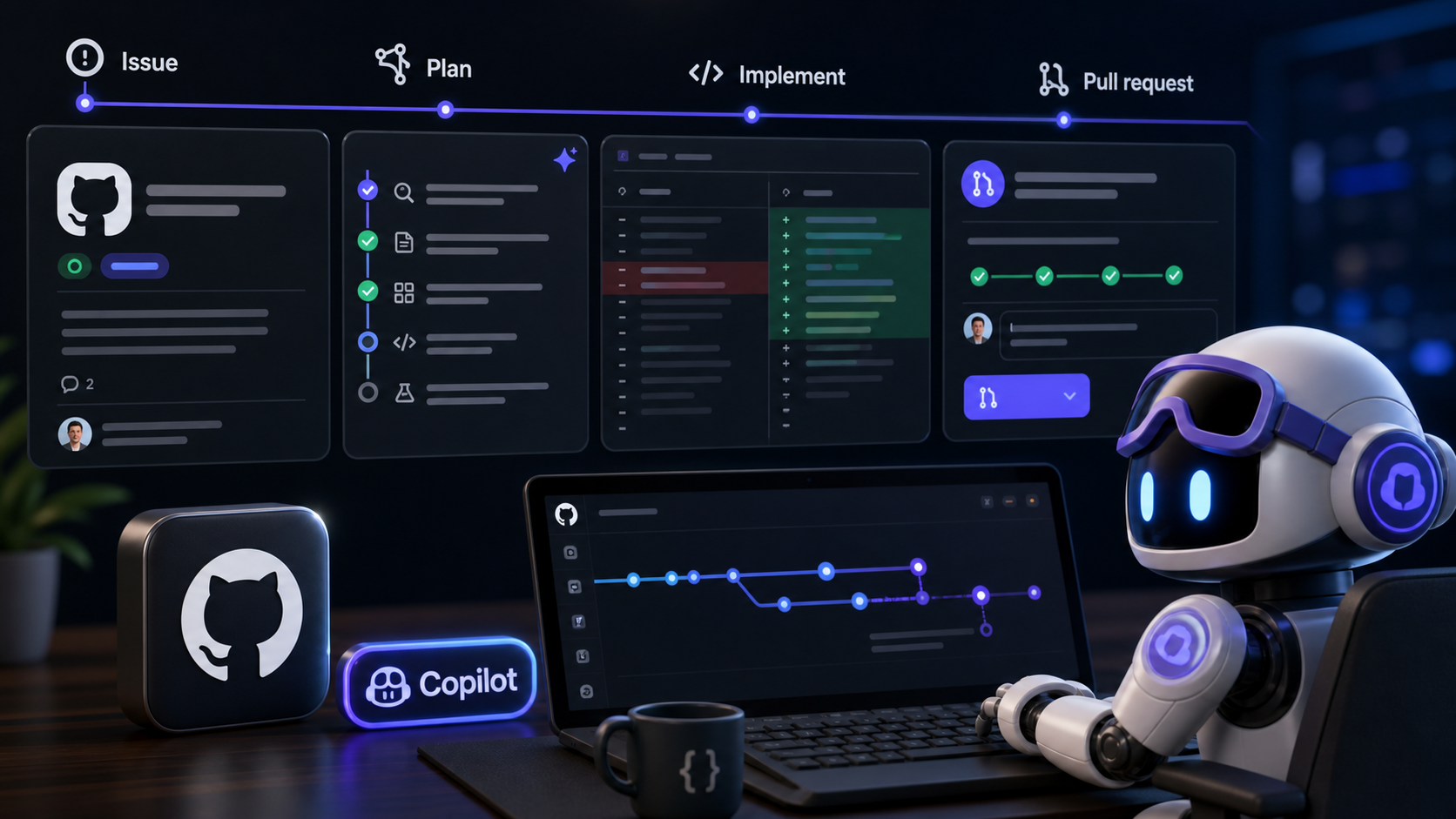
The GitHub Copilot experience is expanding to Slack, bringing Copilot CLI and Copilot app capabilities into Slack in public preview. The announcement notes collaboration with @GitHub and confirms the feature is in public preview.
GitHub Copilot can be engaged inside Microsoft Teams to transform discussions into collaborative, observable agent sessions, with sessions initiated by mentioning @GitHub in a channel, thread, or direct message.
Google's Pixel 11 series adds a new sign-to-text translation feature for ASL users, using a multilingual SL2T model to translate in real time. The feature works with Live Transcribe and Gboard, and translations appear on the outer display.
Google outlines a five-layer interpretation of full-stack AI, detailing how infrastructure, security, research, models & tooling, and products come together to speed, secure, and improve Google’s AI products, as explained by Paige Bailey of Google DeepMind.
GitHub has enabled pinning saved views directly to the repository issues sidebar, allowing users to quickly access their most-used views from within Issues.
OpenAI has introduced a new blog, Introducing AI Futures, to explore how transformative AI could reshape power, governance, the economy, and individual freedom.
GA announcement for the Windows 11 ARM64 image with Visual Studio 2026 on GitHub-hosted runners, including guidance to update GitHub Actions workflows.
Cloudflare announces scope customization for OAuth, allowing optional scopes and narrower grants at authorization time. The change aims to improve security without overwhelming users, and will be expanded to more Cloudflare products in the coming weeks.
Google introduces new personalization tools across Search, Discover, and News, including a publisher-embedded Preferred Sources button, real-time topic tuning for Discover, and customizable audio briefings in News.
A new digital hub from Google Arts & Culture and the National Park Service gathers heritage and natural wonders from sixty national parks, plus AI-driven storytelling experiences at Independence National Historical Park.
GitHub Code Quality now records enablement, disablement, and setting changes in repository audit logs, introducing three new events to track these actions.
Google's AI Max platform adds capabilities to test budgets and ROI targets across multiple Search campaigns in a single A/B test, preserve brand and location guardrails, and apply performance recommendations with one click.
GitHub's changelog announces a new dismissal option for code scanning alerts: operators can dismiss an alert with the Mitigated reason when a vulnerability remains in the code but external controls are in place.
GitHub has rolled out a dedicated Actions path for code quality workflows using CodeQL, allowing Code Quality runs to be reported separately in run histories and usage reports.
Waymo is extending Google's Gemini to its purpose-built Ojai autonomous vehicles, offering riders an in-car AI assistant that can be engaged from the cockpit to control cabin settings and learn about the surrounding area. The Gemini assistant operates independently of the Waymo Driver and remains inactive until a rider chooses to engage it.
Replit has introduced Free Mode, a new option powered by GPT-5.6 Luna, aimed at letting anyone turn ideas into working software without worrying about token costs.
Three renowned advertisers use Google Flow to create studio-quality campaigns for local businesses as part of The Small Brief project, highlighting AI-assisted storytelling.
GitHub introduces a Trends tab in the organization-level Code Quality dashboard, enabling teams to monitor how code quality evolves across repositories over time rather than relying on a point-in-time snapshot.
Cloudflare publicly documents a re-evaluation of remote Spectre attacks against Cloudflare Workers, detailing a proven remote leakage in production and the subsequent defense enhancements that reduced risk.
OpenAI’s ChatGPT Ads is expanding its footprint in Europe, covering 31 European markets and offering advertisers new opportunities to reach users during the decision-making process.
GitHub announces enterprise managed settings for Copilot in JetBrains, enabling centralized controls for plugin governance, MCP server access, OpenTelemetry, and permission modes across organizations.
AI-driven flood forecasting expands beyond river floods through Groundsource and Flood Hub, enabling predictions across 150 countries and marking open data initiatives for meteorological agencies.
Google's Gemini app now provides full-length, on-demand SAT practice tests at no cost, using rigorously vetted content from The Princeton Review, with instant feedback and explanations to help students study more effectively.
GitHub has introduced token-type and user-specific actions to deauthorize and revoke user credentials during security incidents, expanding its self-service credential revocation capabilities.
OpenAI says it is tightening monitoring, alignment, and security for frontier AI models, with safeguards designed to guide the pace of model development.
OpenAI announces an initiative to bolster democratic oversight of AI in national security, focusing on tools, training, and expertise for government institutions.
OpenAI has announced funding for 14 independent projects focused on developing new AI policy ideas to expand economic opportunity and bolster societal resilience in the Intelligence Age.
Gemini and Pixel have entered long-term partnerships with five major European football clubs to bring fans closer to the game through AI personal intelligence and smartphone-enabled content, including behind-the-scenes footage and club-specific wallpapers.
Runware launched the Sonic Inference Pod, a transportable modular data center aimed at making AI inference capacity faster to deploy and easier to place.
SpaceX first public earnings call put aggressive Starlink, compute, and launch forecasts beside the more cautious operating targets investors can measure.
AWS is bringing OpenAI models, Codex, and managed agents into Amazon Bedrock limited preview. Developer teams should plan for governance, identity, and cost controls.
Xcode 27 brings agentic coding and new Apple Intelligence frameworks to app development. Here is how teams should evaluate the workflow before scaling it.
Meta acquired humanoid robotics startup Assured Robot Intelligence for an undisclosed amount. The deal points to a wider push from digital models into physical work.
Stripe Projects is now available to everyone, letting developers or agents provision the services needed to deploy internet products from where they write code.
Anthropic acquired computer-use startup Vercept and plans to shut down its Vy product. The deal reflects the race to make agents operate full desktop workflows.