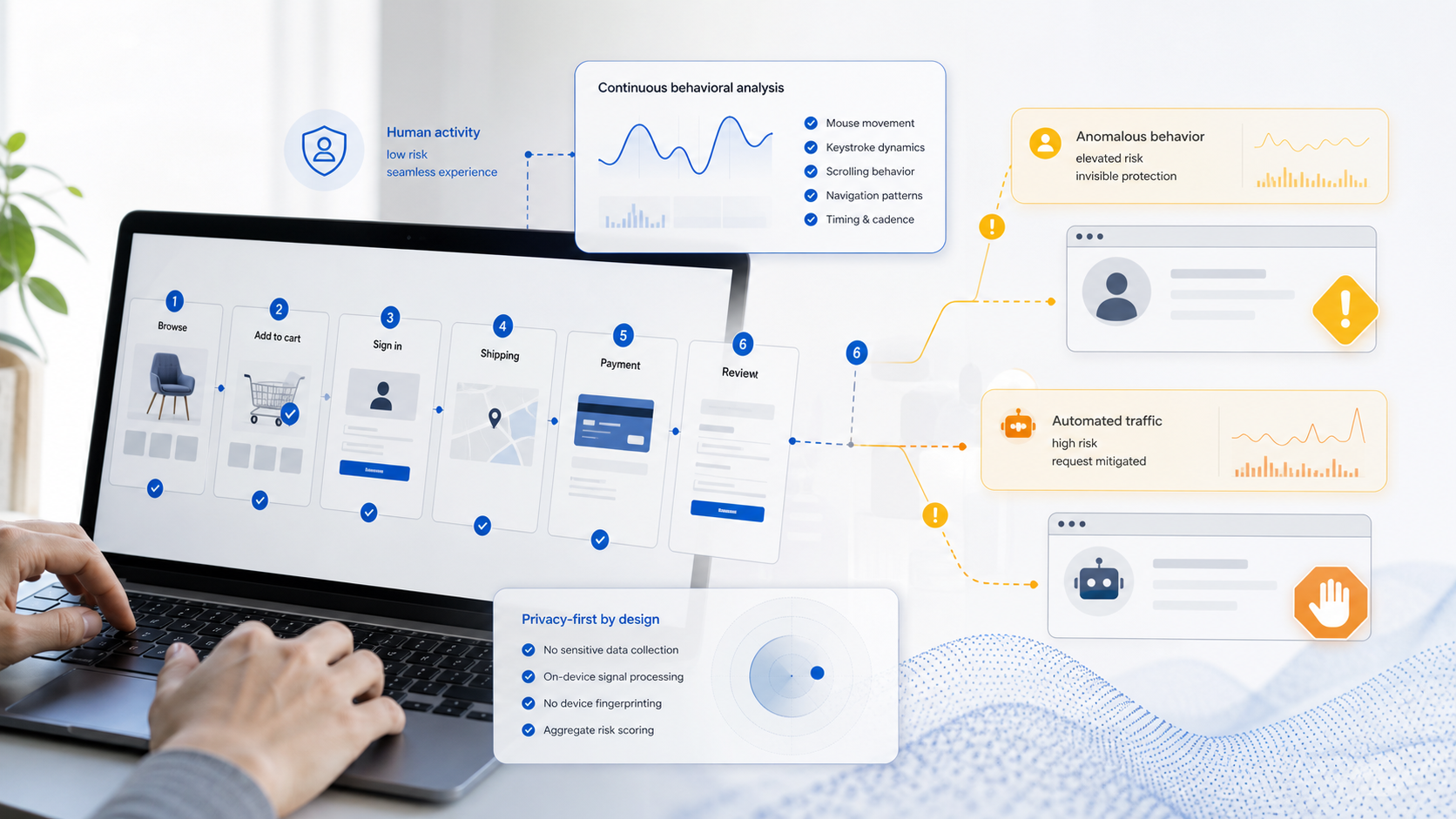
Cloudflare introduced Precursor as a continuous behavioral validation system for bot management. Instead of relying only on a checkpoint such as a challenge page, Precursor collects signals during a visitor session and feeds them into bot protection in real time.
The company positions the feature as a way to identify automated and agentic traffic without adding unnecessary friction for legitimate users. That matters most on login, signup, checkout, and account-management flows where both false positives and missed bots are expensive.
WHY BOT DEFENSE IS CHANGING
Traditional bot defenses often interrupt the user at one point in the journey. Modern automation can be more adaptive, and AI agents can mimic ordinary browsing patterns more convincingly than older scripts.
A continuous approach gives defenders more context. Mouse movement, navigation timing, interaction patterns, and session behavior can be evaluated as the visit unfolds. The tradeoff is that teams must understand what data is collected and how it affects privacy obligations.
WHO SHOULD TEST IT
Ecommerce, ticketing, financial services, account creation, and high-abuse SaaS workflows are the obvious candidates. These teams need to block scraping, credential attacks, fake signups, inventory abuse, and checkout automation without punishing real customers.
A phased test should compare conversion rates, challenge rates, false-positive reports, and bot incident volume before and after deployment. Security wins are not enough if the protection quietly breaks legitimate user journeys.
LIMITS TO WATCH
No bot system is final. Attackers adapt, and defenders need layered controls that include rate limits, identity signals, fraud monitoring, WAF rules, and incident review. Precursor should be evaluated as part of a defense stack, not as a magic replacement for it.
Teams should also confirm how the feature behaves for accessibility tools, privacy-focused browsers, and users on constrained devices. Low-friction security is only low friction if legitimate users are not caught in the net.
BOTTOM LINE
Precursor reflects where bot defense is heading: less visible friction, more session context, and more attention to automated agents. The right test is whether it reduces abuse while keeping the checkout, login, and signup experience uneventful for real users.