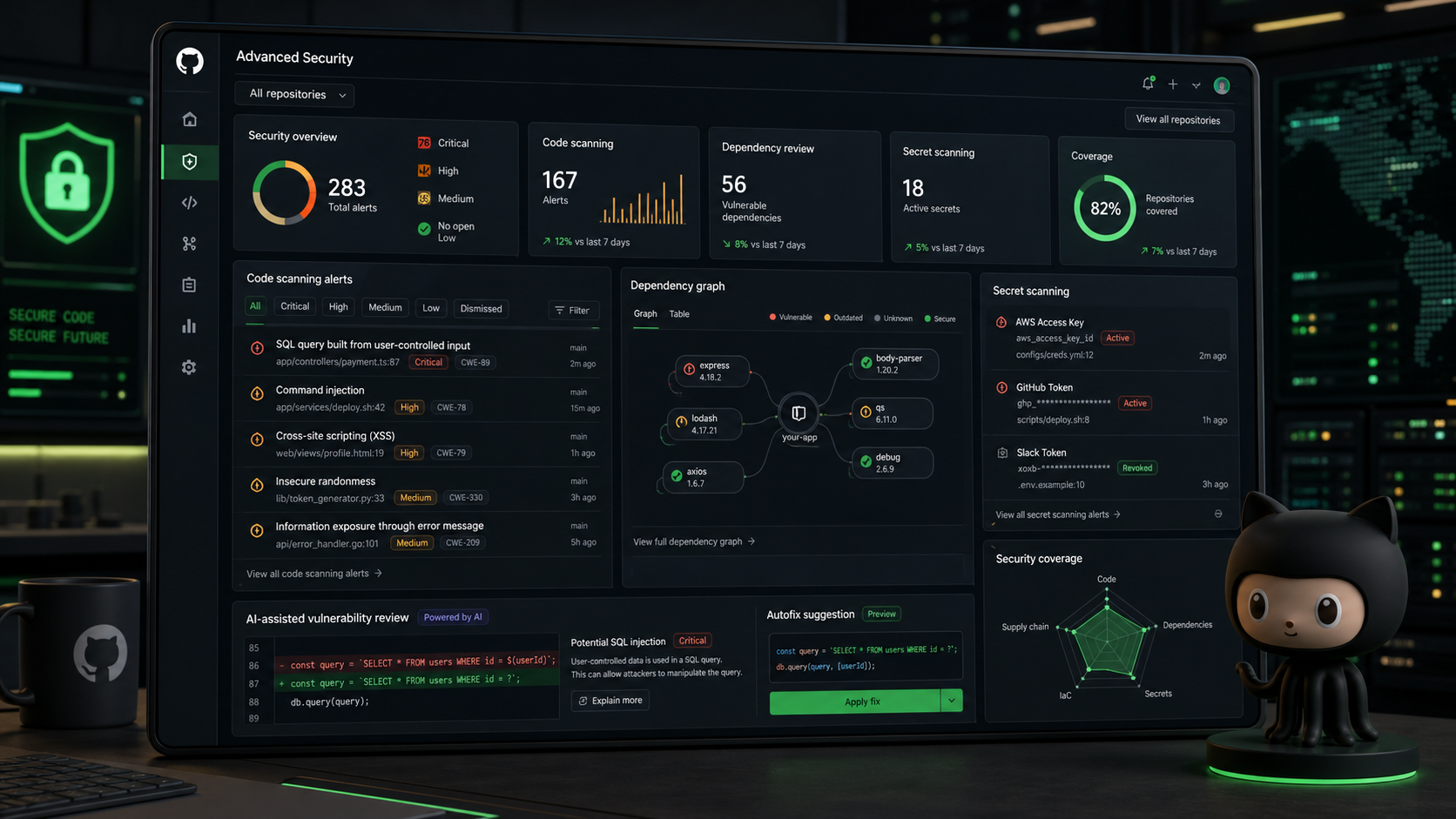
What happens when vulnerabilities are discovered faster than you can fix them? Frontier AI is changing how quickly vulnerabilities can be discovered and exploited. The next challenge is bringing that same speed to remediation and prevention, inside the software factory.
We’re entering a new era of application security; Frontier AI models are uncovering complex flaws that traditional tools overlooked, and attackers are using the same models to exploit them faster. Remediation isn’t keeping pace: Verizon’s 2026 Data Breach Investigations Report (DBIR) measures the median time to fully remediate a known-exploited vulnerability at 43 days, up from 32 in 2025.
WHAT THE VERIFIED EVIDENCE INDICATES ABOUT TOOLING AND WORKFLOW
Security teams face ongoing pressure from growing application portfolios, third-party dependencies, and new disclosures. While agents that find vulnerabilities and write fixes are increasingly accessible, integrating them into how enterprises actually build and ship software remains challenging.
HOW AGENTIC REMEDIATION COULD FIT INTO THE SOFTWARE FACTORY
At GitLab, frontier AI-enabled capabilities are designed to connect discovery, remediation, and prevention in a single trusted workflow inside the software factory. An agent can generate a patch in seconds, and changes are routed through pipelines that check against real builds, tests, and security policies.
- GitLab Orbit provides live context of the software lifecycle to connect findings to changes
- Duo writes a fix and reruns scans and tests within the existing pipeline
- Policies must be enforced at every step to prevent unsafe changes from shipping
WHAT REMAINS UNCERTAIN OR DIFFICULT
While automation promises speed, the reliability and auditability of autonomous patches remain critical questions. A generated patch must be tested, security policies enforced, changes reviewed and approved, and the fix safely deployed to production. The evidence does not establish independent benchmarking beyond the claims in the GitLab post.
Organizations may struggle to scale agent-driven remediation across thousands of projects while maintaining consistent controls and avoiding production risk.
WHAT THIS MEANS FOR READERS DECIDING HOW TO ACT
Readers should understand that discovery can be accelerated by frontier AI, but remediation requires embedding automation within standard software factory controls. The evidence supports pursuing integrated workflows that couple discovery with automated remediation and policy enforcement, rather than treating automation as a standalone capability.
Decisions should consider governance, testing rigor, and alignment with existing security standards when adopting agent-driven remediation in large teams and multi-repo environments.
RELATED COVERAGE
- GitLab Dependency Firewall blocks risky packages before the build (early access)
- GitLab’s Business Logic Security Analyzer: what verified evidence reveals beyond the announcement
- GitLab arms developers with cost controls for AI agents via Duo Agent Platform and Orbit
- GitLab’s agent orchestration cuts the wait between development stages with Duo Agent Platform
- Developer Tools articles
SOURCES
- GitLab: What happens when vulnerabilities are discovered faster than you can fix them? Published · Primary source